
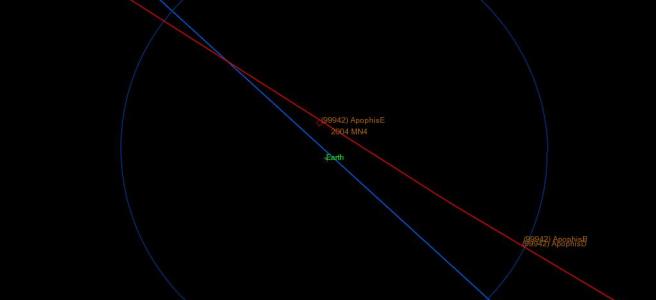
On June 19th, 2004, astronomers Roy Tucker, David Tholen, and Fabrizio Bernardi at the Kitt Peak National Observatory in Arizona, USA, discovered an asteroid that sent alarm bells ringing. Subsequent calculations and observations in December of the same year left about a 3% chance that it would collide with the Earth in 2029. Later, astronomers downgraded the threat, and multiple follow-up observations revealed that on April 13th, 2029, the asteroid will pass the Earth at a distance of about 31,000 kilometers, about one-tenth the Moon’s orbit. However, it is so close that it will be visible to the naked eye in the Eastern hemisphere.
Closely following this near-miss, ‘Origins, Spectral Interpretation, Resource Identification, and Security-Regolith Explorer–APophis EXplorer’ (OSIRIS-APEX), a spacecraft by the National Aeronautics and Space Administration (NASA), will tail the asteroid and reach a distance of about a kilometer from its surface in June 2029. The spacecraft will take images and gather data that will help the scientists learn more about the asteroid. The spacecraft will orbit it for a few months, all the while mapping the surface and relaying back data that will reveal its chemical characteristics. Then, it will land on the asteroid, dig up the surface to about 15 feet, and help scientists figure out what lies below.
If all goes well, in the 25 years since its discovery, scientists will have come a long way from fearing a catastrophic collision to executing a rendezvous.
Near-earth asteroids
Astronomical distances are so large that it is difficult to imagine the vastness of space separating different objects. So, it helps to compare between large distances. For example, the distance between the Earth and the Sun is nearly 150 million kilometers, while the Earth and the Moon are about 0.4 million kilometers apart. Although it is difficult to imagine either distance, the comparison helps us understand why, despite the Moon’s diameter being about 400 times smaller than the Sun’s, the two objects appear to be of the same size in the sky.
If an asteroid orbits the Sun to within 30% of the Earth’s orbit, there is a potential for a collision with the Earth. Astronomers call more than 37,000 such objects “near-earth asteroids” and observe them closely. Those among them that orbit at less than 5% of the Earth-Sun distance from the Earth and are larger than about 140 meters can be potentially hazardous.
An ancient space-rock
Born directly from gas and dust in the nascent solar system about 4.6 billion years ago, somewhere between Mars and Jupiter, asteroid 99942 Apophis is a rock of about 340 meters in diameter and 450 meters in length. It weighs roughly about 60 billion kilograms, peanuts compared to large planets like Jupiter, whose gravitational effects caused its orbit to shift near the Earth.
While observatories around the world have tracked the asteroid extensively to study its properties, its small size means it reflects little sunlight. Moreover, it is also frequently blinded by the Sun. So, its exact shape and chemical composition are not well understood. Astronomers estimate that it is elongated and contains two lobes, and hence, looks like a peanut.
Discovery, scare, and naming
When Tucker, Tholen, and Bernardi discovered the asteroid, the weather played spoilsport, and they could not track its trajectory for more than two days. In December 2004, a team of astronomers at the Siding Spring Observatory in Australia spotted and observed it. Their December 26th calculations caused the 3% alarm, but within two days, careful analysis of the collected data vastly reduced the chances of a 2029 collision.
During the discovery, the asteroid had the name “2004 MN4,” which designated the year, week, and serial number in which it was discovered. The initial scare, however, was enough for the trio to name it after Apep, the nemesis of an ancient Egyptian sun god, Ra. Apep symbolises evil and destruction.
99942, the number in front of its final name, comes from the catalog number of the trio’s astronomical survey. Such a number is assigned after astronomers measure the asteroid’s orbit to reasonable precision via independent observations. So, the number 99942 reminds us that today, astronomers are certain about the asteroid’s future trajectories. It will not collide with the Earth.
Still, it took astronomers multiple follow-up observations with radio and optical telescopes to completely rule out the possibility of any collision in this century, the relief coming as late as 2021.
Close fly-by
OSIRIX-APEX will be the first to analyze the asteroid’s shape, structure, and composition closely after its 2029 encounter, which will change its trajectory significantly. In a one-of-kind encounter, the Earth’s gravitation will fling it into a slightly larger orbit around the Sun, of about 1.2 Earth years, from its present of about 0.9 Earth years. Astronomers believe there hasn’t been such a close encounter in human history.
References
- https://doi.org/10.1007/s11038-007-9165-3
- https://doi.org/10.1016/j.icarus.2017.08.032
- https://doi.org/10.1016/j.epsl.2004.03.004
- https://science.nasa.gov/solar-system/asteroids/apophis/
- https://science.nasa.gov/mission/osiris-apex/
- https://science.nasa.gov/solar-system/asteroids/apophis-facts/
- https://www.space.com/apophis
- https://skyandtelescope.org/astronomy-news/apophis-pays-a-visit-this-week/
- https://cneos.jpl.nasa.gov/about/neo_groups.html
- https://cneos.jpl.nasa.gov/stats/totals.html
- https://archive.ph/20120529114151/http://www.astronomy.com/en/sitecore/content/Home/News-Observing/News/2005/08/Asteroid%20Apophis%20set%20for%20a%20makeover.aspx
- https://www.minorplanetcenter.net/iau/info/HowNamed.html
- https://news.westernu.ca/2024/03/apophis-miss/
Header image via Wikimedia Commons.
GenAI was not used to generate or edit any part of the above post.
 Debdutta Paul