
I investigate the claims and counter-claims of what dark energy is up to.
This story has been sitting with me since it was decommissioned by a physics publication on April 21, 2025, the filing date. So here it goes.
Jun 15, Bengaluru: There are tell-tale signs that something is wrong with how physicists describe the universe. Cosmologists — physicists who study the universe as a whole — are increasingly at odds with what exactly the problem is.
At the centre of the present controversy is dark energy. But what is it?
Einstein’s equations in general relativity — the theory of gravity that has withstood all experimental tests for a century — apply to the universe as a whole. A particular solution is useful due to its simplicity and is often referred to as the standard cosmological model. It describes the universe as composed of matter (galaxies, galaxy clusters, etc.) and energy spread out uniformly and equally in all directions, known as the ‘cosmological principle’. Data from the twentieth century showed galaxies flying apart from each other — faster the more distant they were — which the model neatly explained via the ‘Hubble constant’ or the universe’s expansion rate. Using this rate, the model predicted patterns in the cosmic microwave background radiation — relics of the Big Bang — that matched the observations of the telescopes exactly. As a result, it became a widely accepted model. In 1998, cosmologists discovered the universe’s expansion is accelerating over time, which led to them winning the Nobel Prize in Physics in 2011. They explained the expansion’s acceleration by proposing an invisible energy that pulls the universe away and named it ‘dark energy’. What exactly dark energy is, cosmologists do not yet understand, but it fits neatly into Einstein’s equations of general relativity.
Recently, some have claimed it is weakening over time. At least two independent groups of researchers dispute this interpretation, questioning the fundamental assumption of the cosmological principle, against which, they claim, there is emerging evidence. Either way, the universe is not as straightforward as physicists thought it was even a decade back.
How cosmologists study the universe
Cosmologists are in the dark not only about dark energy but about another component of the model, which they call the ‘dark matter’. It makes up about 85% of the universe’s matter, led to the formation of galaxies, and today holds the stars together. Dark matter and dark energy together make up about 95% of the universe’s matter and energy content.
Cosmologists employ various methods to arrive at these numbers. One method is to carefully observe the relics of the Big Bang, which also allows for the calculation of the Hubble constant. Another is by observing supernovae — the explosions of dense stars called white dwarf stars — and quasars, which are jets emanating from black holes at the centres of galaxies.
Cosmologists also follow the imprints of ancient sound waves — from the moments right after the universe’s birth when it was a hot, dense soup of matter and radiation. The waves left an imprint on electrons and protons in the early universe that eventually formed all galaxies. They measure the exact distances of hundreds of thousands of galaxies, which require extremely precise data showing how light from the galaxies spread out in different wavelengths, or their ‘spectra’. By studying the distribution of these galaxies across space and time, cosmologists can deduce fundamental parameters of the universe, including the proportion of dark matter and dark energy.
To date, the standard cosmological model has been effective in explaining the distribution of galaxies. A recent study of 14 million galaxies and quasars’ spectra by the Dark Energy Spectroscopic Instrument (DESI) team claimed hints — not conclusive evidence — that deviate from the earlier observations. They interpreted this result by claiming dark energy has weakened as the universe has aged.
What is wrong with the standard model?
Other researchers, however, point to a more nuanced approach. They claim that the cosmological principle does not accurately describe the universe, making the standard cosmological model invalid. It has worked for all these years because physicists haven’t studied such vast amounts of data as they are now — 14 million galaxies and quasars.
Mohamed Rameez, a professor at the Tata Institute of Fundamental Research in Mumbai, said the cosmological principle is akin to assuming the Earth is a perfect sphere. It works until it doesn’t. Then, physicists move on and take into account the imperfections — that it’s an oblate spheroid, that there are fluctuations on the ground that make it far from smooth, etc. According to Rameez, the DESI researchers’ work is like assuming the Earth is spherical.
A recent study by the Rameez group, led by PhD student Animesh Sah and published in The European Physical Journal C on May 30, 2025, has claimed tell-tale evidence that the universe around the Solar System isn’t the same in all directions. Analysing 1701 supernovae via their spectra, the team concluded that the Earth, by virtue of its being in the Milky Way, is part of a local flow of galaxies. It’s like being in traffic, where there’s a cluster of vehicles moving differently from the average.
Physicists do expect the Solar System’s motion to affect our observations of the universe, including those of the cosmic microwave background. However, the team observed that the non-uniformity of the supernovae and the non-uniformity of the cosmic microwave background radiation do not cancel each other out, as expected from the standard cosmological model.
However, Rameez could not exactly pinpoint the source of the discrepancy. Cosmologists have speculated that there is a ‘Great Attractor’, a hypothetical astronomical object that is pulling the galaxies nearby. But, “it has so far not been found. We don’t know what exactly it is,” he said. But, he added, it’s not difficult to imagine a large amount of currently undiscovered matter about 1 billion light years away, in line with Einstein’s general relativity. “It doesn’t require unknown physics to explain it,” he said.
Moreover, the group found the Hubble constant is also not the same in all directions. It’s not yet clear whether that could solve another cosmological crisis — the Hubble crisis. Astrophysicists measuring the constant have increasingly found different answers when they have measured it via supernovae versus from the imprints of the cosmic microwave background radiation.
While supernovae are found at closer distances, there are other objects, such as quasars, that are detected from much further away. Independent studies with quasars have, over the years, suggested that they are differently numbered in different directions, which does not match the discrepancy of the cosmic microwave background. Studying 1.36 million quasars, they concluded the Solar System’s motion cannot explain the quasars’ preferential distribution in the sky. So, a standard test, called the ‘Ellis-Baldwin test’, has stood the test of time.
The discrepancies suggest our universe has an inherent preference in the way matter and energy are distributed. And question whether dark energy is weakening.
The claims and counter-claims
Shadab Alam, also a professor at the Tata Institute of Fundamental Research in Mumbai, who works with the DESI team, notes that the quasar data can be prone to errors. Simply, at such large distances, it becomes difficult to figure out which are stars and which quasars, and the distribution of the quasars depends on these calculations. This, he said, raises doubts about the claims of the quasars’ non-uniformity.
While admitting the quasars’ non-uniform distribution would be interesting, he said that the DESI team estimates the quasars’ distribution in the sky only from those for which they can measure their spectra, which pin down their distances exactly. So, he said, he prefers a simpler model of the universe that explains the data they can be sure of.
Subir Sarkar, a professor at the University of Oxford and one of the collaborators questioning the standard cosmological model, disagreed with Alam. He said the observational effects that Alam mentioned cannot impact two kinds of astrophysical sources. He said that the group found that galaxies, which are observed with radio waves and are relatively closer to the Milky Way compared to the quasars, also show a similar mismatch. Since these “radio galaxies” and quasars are independent datasets, the combined dataset gives strong evidence of the directional mismatch. “Their systematics are completely different, and they’re giving the same answer,” said Sarkar.
David L. Wiltshire, a professor at the University of Canterbury, Christchurch, New Zealand, agreed with Sarkar. He has developed the ‘timescape model’, which proposes a more radical solution to the confusion: dark energy does not exist. The expansion’s acceleration, he claims, is an illusion stemming from the assumption of the cosmological principle.
The point is simple. General relativity does not imply the universe is similar everywhere and in all directions, so there is no need to assume this while describing the universe. The timescape model takes the fluctuations of matter and energy in the universe seriously — while being consistent with relativity — instead of wishing them away as due to the Solar System’s movement in its vicinity. Last year, his group claimed the timescape model explains supernovae datasets better than the standard cosmological model.
Sarkar, however, thinks that there is no need for speculations given the large amount of data the DESI experiment has collected. “The DESI experiment is beautiful,” he said, arguing that the DESI team is in the best situation to test the cosmological principle right away. “They have got millions and millions of very precise… measurements.” So, he is surprised that the team hasn’t yet attempted to test the cosmological principle.
Alam agreed but offered an explanation: the current DESI dataset is limited in its ability to conduct the test with certainty, he said. The DESI team is collecting more data, he said, and they will eventually reach a stage where they can perform the test conclusively. “The situation has not arrived yet.”
The present situation also means that other researchers interested in carrying out the test with the DESI dataset will need significantly more time to analyse it.
As of now, the DESI team maintains its position: the discrepancies are due to a weakening dark energy.
The future
The researchers I spoke to mentioned future cosmological experiments will collect even more data in the next few years. Particularly, the upcoming Vera C. Rubin Observatory will begin the Legacy Survey of Space and Time later this year. Wiltshire said the timescape model predicts different outcomes compared to the standard cosmological model, and the survey will put the models head-to-head.
Cosmologists, divided by what the present datasets mean, are on the edge as deep answers about the universe lurk on the horizon. While different groups have different theories, they all look forward to the next few years to figure out what exactly dark energy is up to.
Or if it exists at all.
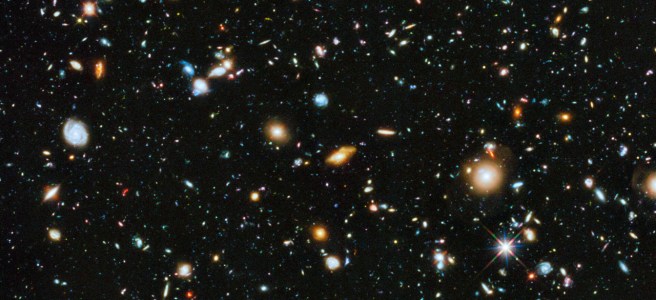
Representative header image via Wikimedia Commons/NASA.
Not a single alphabet in this story was generated by artificial intelligence.
 Debdutta Paul
Enlightening article on a crucial topic. Very well written.
LikeLiked by 1 person